How to Choose Between Two Games When Both Have the Same House Edge
When two games share identical house edges, a second layer of math determines which one actually fits your bankroll, session length, and risk tolerance.
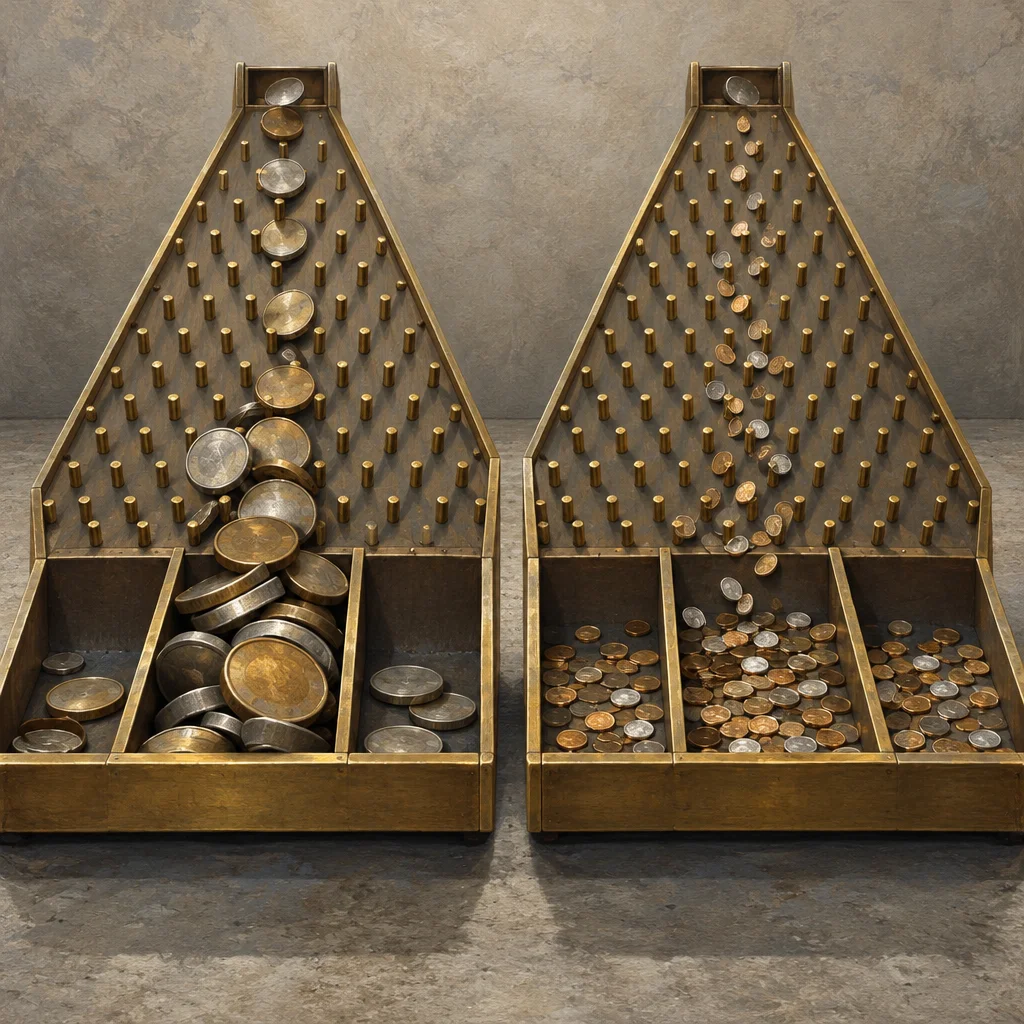
The house edge is the number most gamblers reach for when comparing games. If one game costs 1.5% per bet and another costs 5%, the choice feels obvious. But a problem appears when two games sit at roughly the same house edge. At that point, most players shrug and pick by feel. There is a better way, and it requires only one additional concept: variance.
What the house edge tells you, and what it leaves out
The house edge tells you the average percentage of each bet the casino keeps over a very large number of rounds. If a game has a 2% edge and you bet $10, the expected cost per round is $0.20. That number is real and useful. What it does not tell you is how widely your actual results will scatter around that average in a single session.
Two games can share a 2% house edge and behave almost nothing alike during a two-hour visit. One might return small, frequent wins and losses. The other might go many rounds with no return at all, then pay out a large amount. The average cost is the same. The experience, and the financial risk, is very different.
The statistical word for that scatter is variance. High variance means outcomes spread far from the average. Low variance means they cluster closer to it.
A simple way to see variance in a hypothetical game
Imagine two purely hypothetical games, each with a 2% house edge and a $10 flat bet.
Game A pays even money on a roughly 49% chance of winning. Each round, you either win $10 or lose $10. The swings are modest. Over 100 rounds, your total wagered is $1,000. Your expected loss is $20 (2% of $1,000). In practice, your actual result will usually land somewhere in a range around that $20 figure, but the individual bets are small and symmetric, so the range is relatively contained.
Game B pays 9-to-1 on an approximate 9.1% chance of winning. You win $90 or lose $10 each round. The expected loss per $10 bet is still about $0.20, and $20 across 100 rounds. But because big wins are rare and losses are frequent, your session results scatter much more widely. In 100 rounds you might lose every bet and end down $1,000, or catch two wins and be up $80, or land somewhere in between. All of those outcomes share the same house edge.
Neither game is better in an absolute sense. They just behave differently, and that behavior matters depending on who is playing.
How your bankroll interacts with variance
If your session bankroll is $200 and you play Game B at $10 per round, a realistic bad run of 20 consecutive losses wipes it out before variance has any chance to average out. That is not a freak event with this kind of payout structure; long losing streaks are built into the math when wins are infrequent.
Game A with the same bankroll and the same bet size would absorb most realistic bad runs at that stake. Even a rough sequence of losses is unlikely to eliminate a $200 bankroll in a typical session.
This leads to a practical suggestion: when two games share the same house edge, choose the one whose variance fits the ratio of your bankroll to your bet size. A rough guide is to estimate how many bets your bankroll covers. If that number is small, a lower-variance game gives your expected value more time to matter and reduces the chance that one bad run ends your session early. If your bankroll covers a very large number of bets, higher variance becomes less threatening because you have the depth to absorb the swings.
Session length matters too
Variance becomes less dominant as the number of rounds increases. Over thousands of rounds, actual results tend to drift toward the mathematical expectation. Over dozens of rounds, the scatter dominates and almost anything can happen.
If you are planning a short session, high variance means your actual outcome is almost entirely determined by luck rather than the edge. That is not a reason to avoid the game, but it is a reason to understand that your result tells you very little about the game's true properties. A short, lucky session at a high-variance game is not evidence that the game is generous. A short, unlucky session is not evidence that you should switch games.
Longer sessions at lower-variance games give the house edge more room to express itself, which is a double-edged observation. You are less likely to end dramatically up or down, but you are also more likely to end close to the mathematical expectation, which for a negative-expectation game means a predictable loss.
A practical decision framework
When two games share the same house edge, work through three questions before choosing.
First, how many bets does your session bankroll cover at your intended stake? Divide bankroll by bet size to get a round count. A ratio below roughly 50 suggests favoring lower variance. Above 200, variance is less urgent as a tiebreaker.
Second, what outcome range are you comfortable with? If a large upside swing would be satisfying even knowing it is unlikely, higher variance fits that preference. If finishing close to where you started feels better than a wide range of possibilities, lower variance fits that preference. Neither preference is wrong; they are just different.
Third, how long do you plan to play? Short sessions amplify the role of variance. Longer sessions allow more of the mathematical structure to show up in your results, though even long sessions in gambling terms are short by statistical standards.
The limits of this framework
This approach helps you make a more informed choice between equal-edge games. It does not change the house edge itself, and it does not give you a method to win. Both games still have a negative expected value. Choosing the lower-variance option reduces the chance of a dramatic loss but also reduces the chance of a dramatic gain. Choosing higher variance does the opposite. Neither path beats the house; they simply distribute the same expected cost differently across your session.
The useful takeaway is that house edge alone is not enough information to compare games. Variance is the second number, and once you start asking about it, the choice between two apparently identical games becomes a real, answerable question rather than a coin flip.