How to Set a Loss Limit That Is Actually Grounded in the Math of Your Game
A loss limit only protects you when it is sized to the statistical spread of your specific game, not picked from thin air.
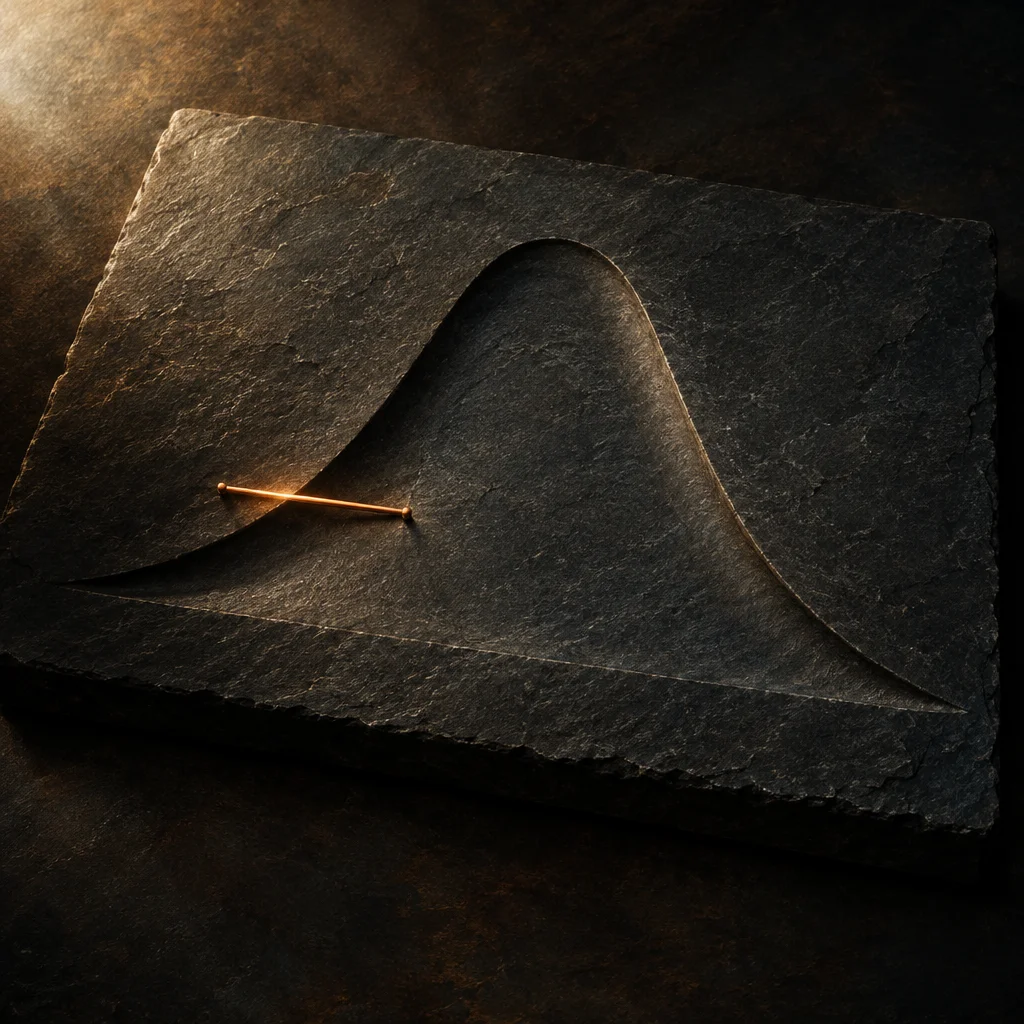
Most players who set a loss limit pick a number that feels uncomfortable enough to count as discipline. Fifty dollars, a hundred, whatever produces a mild wince. That number often has nothing to do with how the game actually behaves, which means it either cuts a normal session short for no good reason or offers no real protection at all. There is a more grounded way to arrive at the figure, and it requires knowing two things about your game before you sit down.
The Two Inputs That Actually Matter
The first input is the house edge, which tells you the average cost per dollar wagered over a very large number of bets. The second is the standard deviation per bet, which measures how far individual results tend to scatter around that average. House edge tells you where you are heading on average. Standard deviation tells you how rough the road is getting there.
A game with a low house edge but high variance can still hand you a large loss in a short session even when you are playing exactly as expected. A game with a modest house edge and low variance tends to produce results that cluster closer to the expected loss. A loss limit that ignores variance is a limit set in the dark.
A Concrete Hypothetical Example
Suppose you are playing a hypothetical flat-bet table game with the following assumed properties: a house edge of 1.5 percent, a standard deviation of approximately 1.0 per unit wagered per round, and a pace of 60 rounds per hour. You plan to bet one unit per round and you are thinking about a two-hour session.
Over 120 rounds, your expected loss is 120 rounds multiplied by 0.015, which equals 1.8 units. If you bet ten dollars per round, the expected loss is about eighteen dollars. That is the average destination, but not every session lands at the average.
To estimate the spread of outcomes, you use a simplified version of the session standard deviation. It is the single-bet standard deviation multiplied by the square root of the number of bets. For 120 bets with a per-bet standard deviation of 1.0, the session standard deviation is the square root of 120, which is approximately 10.95 units, or about 109 dollars at ten dollars per bet.
In a normal distribution, roughly 68 percent of sessions land within one standard deviation of the expected result. One standard deviation below expected means a loss of roughly 18 plus 109, which is 127 dollars. Two standard deviations below expected, which covers about 95 percent of sessions on the downside, means a loss of about 18 plus 218, or 236 dollars. These are hypothetical illustrative figures based on assumed inputs, not guarantees.
What Those Numbers Actually Tell You About Your Limit
If you set your loss limit at thirty dollars for this hypothetical game at this stake, you would almost certainly hit it. Thirty dollars is less than one session standard deviation, meaning normal downward swings will repeatedly trigger it. You are not protecting yourself from unusual outcomes; you are stopping during ordinary variance.
If you set your limit at two hundred dollars, you are covering roughly 95 percent of expected session outcomes for a two-hour session at this game and stake. You would only exceed it during genuine statistical outliers, not during unremarkable downswings.
Neither limit is morally correct or incorrect. The point is that the two-hundred-dollar limit corresponds to something real in the math, while the thirty-dollar limit corresponds to a feeling. Only one of those can be planned around.
How to Adjust the Framework for Your Actual Situation
Not everyone knows the precise standard deviation for every game they play, and games vary considerably. A few general patterns are worth knowing.
Games with binary outcomes and near-even payouts, like many basic table bets, tend to have per-bet standard deviations close to 1.0. Games with large jackpot payouts built in have much higher standard deviations because occasional large wins stretch the distribution considerably. Games with multiple simultaneous bets or side bets add more variance than the base game alone suggests.
If you cannot find the exact figure for your game, a conservative approach is to assume a per-bet standard deviation of at least 1.0 and scale your limit from there. For any session where you have a concrete number of planned bets, calculate the square root of that number and multiply by your bet size to get a rough estimate of one session standard deviation. Then set your loss limit somewhere between one and two of those standard deviations below your expected session loss.
That range catches ordinary variance without cutting you off during normal play, while still keeping you from extending indefinitely into the tail of the distribution.
The Limit Only Works If You Treat It as a Hard Stop
The mathematics of a loss limit assume you actually stop. A limit you negotiate with yourself once you hit it is not a limit; it is a suggestion. At that point, you are no longer operating inside the plan you built, and the calculations above no longer describe your actual exposure.
This is not a moral argument about willpower. It is a structural one. The variance calculation for your session assumes a fixed number of bets. Every bet placed after the limit is a new extension with its own expected cost and its own downside range, and that range compounds unfavorably because losses tend to grow the longer you continue in a negative-expectation game.
Setting the limit using actual game math makes it easier to respect, because you know what it represents. It is not an arbitrary number chosen from discomfort. It is the boundary between the range of outcomes you planned for and the range of outcomes you did not.
A Simple Pre-Session Calculation to Try
Before your next session, work through these steps using your own assumed or researched inputs. Decide your bet size and your planned number of rounds. Multiply the number of rounds by your assumed per-bet standard deviation to get a variance figure, then take the square root to get the session standard deviation in bets. Multiply by your bet size to convert to dollars. Multiply your expected loss per round by the number of rounds to get your session expected cost. Add one to two session standard deviations to your expected cost to get a loss limit range that reflects the actual statistical behavior of your game.
The result will probably be larger than what feels instinctively comfortable, and smaller than what feels catastrophically risky. That middle ground is where a grounded loss limit lives.