How to Think About What a Conditional Probability Actually Tells You
When a probability is only valid under a specific condition, treating it as unconditional leads to badly miscalculated risk at the table.
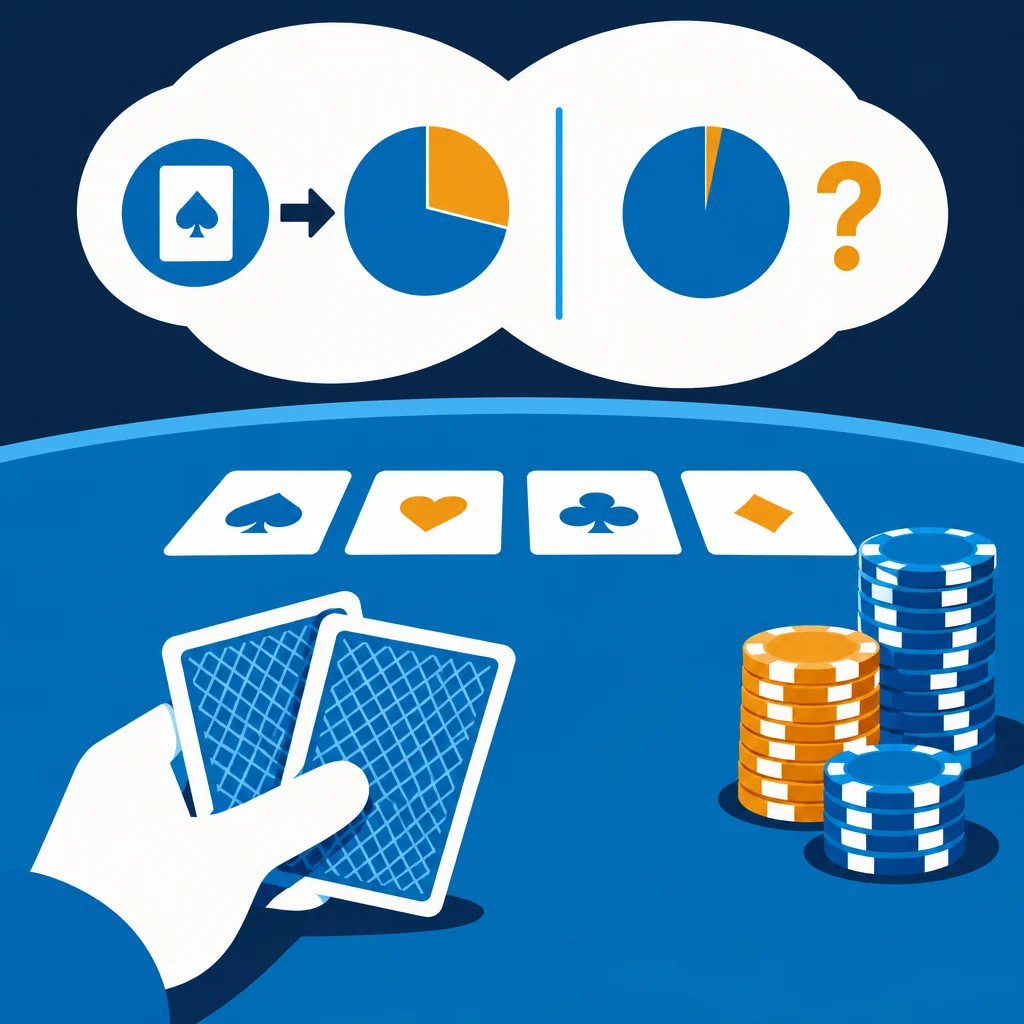
The Question Behind the Question
You have probably heard a statement like this at a table: "Given that the dealer is showing a six, the odds of the dealer busting are pretty good." That sentence contains a conditional probability. It is not telling you the probability of the dealer busting in general. It is telling you the probability of the dealer busting given a specific piece of information that is already true.
Conditional probability sounds technical, but the core idea is straightforward: when you already know something, you work from a smaller, more specific set of possibilities. The unconditional probability ignores that known information. Mixing the two up is one of the most common sources of bad intuition in gambling mathematics.
A Clean Hypothetical to Anchor the Idea
Imagine a simple hypothetical card game. A single standard deck has 52 cards. You draw one card. What is the probability it is a king? There are 4 kings in 52 cards, so the probability is 4/52, which simplifies to about 7.7 percent.
Now suppose you already know the card is a face card. Face cards are jacks, queens, and kings. There are 12 face cards in a standard deck. Given that you already know the card is a face card, you are no longer working with all 52 possibilities. You are working with only 12. Of those 12, exactly 4 are kings. So the conditional probability of it being a king, given that it is a face card, is 4/12, or about 33.3 percent.
Same deck. Same card. Completely different probability, because the condition changed what you know and therefore changed the size of the universe of possibilities you are reasoning over.
Why the Difference Matters in Practice
Conditional probability becomes costly when a player uses an unconditional probability in a situation where the conditional one applies, or vice versa.
Consider a hypothetical scenario at a blackjack-style table. Before any cards are dealt, you might estimate the broad likelihood of various dealer outcomes across all possible starting cards. That is an unconditional view. But once the dealer's upcard is visible, you have real information. The correct probability to use from that point forward is the conditional one: what is the likelihood of this outcome given this specific upcard. Using the pre-deal unconditional number after you have visible information means you are ignoring evidence you actually have.
This is not about finding an edge. It is about making sure your mental model of the situation matches the mathematical structure of the situation. A player who consistently conflates the two will build intuitions that feel right but are quietly miscalibrated.
The Formal Notation, Explained Simply
Mathematicians write conditional probability as P(A | B), which is read as "the probability of A given B." The vertical bar means "given that we already know." The formula that defines it is:
P(A | B) = P(A and B) / P(B)
In plain language: to find the probability that both things are true, divided by the probability that the known condition is true.
Using the face card example above: P(king and face card) is 4/52, because there are 4 cards that are both kings and face cards. P(face card) is 12/52. Dividing: (4/52) / (12/52) equals 4/12, or 33.3 percent. The formula gives the same answer as the intuitive reasoning, which is reassuring.
You do not need to use this formula in real time at a table. But understanding it once gives you a stable mental model for situations where partial information is available.
A Common Trap: Reversing the Condition
One particularly important error is reversing the direction of the condition. P(A | B) and P(B | A) are almost never the same number, and confusing them produces badly wrong conclusions.
Here is a hypothetical illustration. Suppose that in a simplified card game, 80 percent of losing hands contain a certain combination of cards. A player might mistakenly conclude that if they see that combination, they have an 80 percent chance of losing. But that 80 percent is P(combination | losing hand), not P(losing hand | combination). The second probability depends on how common the combination is overall and how often it appears in winning hands too. Without that additional information, you cannot reverse the condition and get a valid number.
This error appears in gambling intuition more often than players realize. Treating a statistic in one direction as though it applies equally in the other direction is a consistent source of miscalibrated expectations.
How This Connects to Independent Events
Conditional probability has a clean relationship with the concept of independence. Two events are statistically independent if knowing one tells you nothing about the other. In that case, P(A | B) equals P(A), because the condition provides no information that changes the probability.
Many casino games are designed around independent events. In games using a shuffled deck replaced between rounds, or in any truly random mechanical outcome, the result of one round carries no information about the next. When events are genuinely independent, conditional probability collapses back to unconditional probability, and that is actually the simpler situation.
Where conditional probability becomes actively important is in games where information is revealed within a round, or where the composition of remaining cards or outcomes shifts as the round progresses. In those structures, conditions update what is knowable, and the math updates with them.
What This Means for Reading Gambling Situations Honestly
The practical takeaway is a habit of asking a two-part question before applying any probability to a decision. First: does this probability assume I know nothing, or does it assume I already know something? Second: does my current situation match that assumption?
If you are working with a probability calculated before any information was revealed, and you now have information, that probability is no longer the right one to use. It is not wrong in an absolute sense. It was correct for the situation it described. But that situation is no longer your situation.
This will not let you overcome a house edge, and it will not change the long-run expected value of a game with fixed rules. What it does is help you reason accurately about the situation in front of you rather than a different situation you mistakenly believe you are in. Accurate reasoning about actual probabilities is the foundation everything else in gambling mathematics is built on.