How to Think About What Rounding in Payout Odds Actually Does to Your Expected Loss
When a game rounds its payout to a clean number, that rounding creates a hidden per-bet cost you can calculate before you sit down.
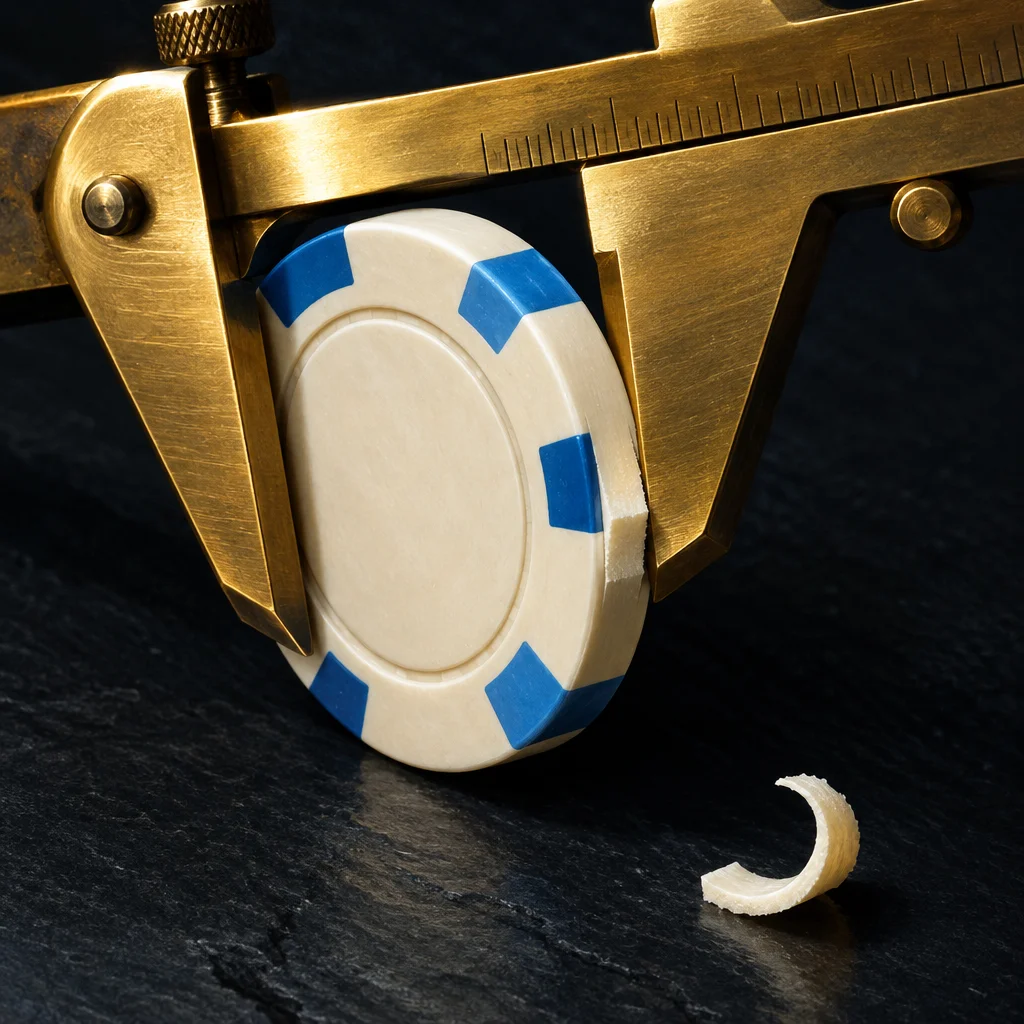
The rounding problem most players never notice
When a casino or sportsbook sets a payout, the number almost always ends in a round figure. You might win $9 for every $1 wagered, or $2.50, or $4. These clean numbers are easier to display, easier to calculate, and easier for players to remember. What they are not, in most cases, is mathematically exact.
True odds are almost never round numbers. When a game has a genuine winning probability of, say, 1 in 9.3, the exactly fair payout would be $8.30 for every $1 risked. No casino offers $8.30. They offer $8 or $9, and the direction of that rounding tells you almost everything about which side of the bet benefits.
This article shows you how to measure the cost of that rounding precisely, using only arithmetic.
What fair odds actually means
A fair payout is the one that gives neither the player nor the house a long-run mathematical advantage. The formula is simple.
If your probability of winning is p, the exactly fair payout on a $1 bet is:
Fair payout = (1 - p) / p
That number represents how much the other side of the bet would pay you in a world with no house profit. For example, if your probability of winning is 1 in 10, written as 0.10, the fair payout is:
(1 - 0.10) / 0.10 = 0.90 / 0.10 = $9.00
If the game actually pays $9, the rounding costs you nothing. If it pays $8, the rounding is working entirely in the house's favor. If it pays $10, the rounding is working in your favor (a situation that essentially never occurs in a commercially operated game).
Calculating the cost of a rounded payout
Suppose a hypothetical game gives you a 1 in 9.5 chance of winning each round. That is a probability of approximately 0.1053.
The exactly fair payout at that probability:
(1 - 0.1053) / 0.1053 = 0.8947 / 0.1053 ≈ $8.50 per $1 wagered
The game pays $8 flat, because $8.50 is awkward to handle. That $0.50 difference per dollar wagered might sound small. Here is what it actually means for your expected outcome.
Expected value per $1 bet, at the rounded $8 payout:
- You win with probability 0.1053, collecting $8: 0.1053 × $8 = $0.842
- You lose with probability 0.8947, losing $1: 0.8947 × (-$1) = -$0.895
- Net expected value: $0.842 + (-$0.895) = -$0.053 per $1 wagered
Expected value per $1 bet, at the fair $8.50 payout:
- 0.1053 × $8.50 = $0.895
- 0.8947 × (-$1) = -$0.895
- Net expected value: $0.895 + (-$0.895) = $0.00
The rounding from $8.50 to $8 introduced a 5.3% house edge where none would otherwise exist. You can run this same calculation on any game where you know the true probability of winning and the stated payout.
Why this matters more than it appears
A 5.3% house edge on a $1 bet costs you an expected $0.053 per round. That sounds inconsequential. But expected value accumulates across every bet you make.
If you place 200 bets in a session at $5 each, your total amount wagered is $1,000. A 5.3% edge means your expected loss for the session is $53. The rounding that looked like a $0.50 rounding shortcut produces a measurable and predictable cost at scale.
The key variable in this calculation is not the bet size alone. It is the product of bet size, number of bets, and house edge percentage. All three multiply together. A tiny edge over many rounds is not a minor issue.
Rounding down versus rounding up
In practice, commercial games almost always round payouts down, not up. Rounding up would give the player a small positive expected value, which is not a stable business model for the operator. So whenever you see a payout that ends in a clean number, the working assumption is that the true fair payout was slightly higher and was trimmed to the nearest convenient figure.
This does not mean the game is dishonest. It means the rounding mechanism is part of how the house edge is embedded, alongside the more visible sources of edge like zero pockets on a roulette wheel or the vig in a sportsbook line.
How to apply this before you play
You need two pieces of information: the game's true winning probability, and its stated payout.
True winning probability is not always advertised, but many games publish it or allow you to derive it from the rules. For a standard coin-flip style game with two equally likely outcomes, the probability is 0.5. For a roulette straight-up bet on a 38-pocket wheel, it is 1/38, or approximately 0.0263.
Once you have both numbers, the calculation is:
- Compute the fair payout: (1 - p) / p
- Compare it to the stated payout
- Compute expected value: (p × stated payout) + ((1 - p) × (-1))
If the expected value is negative, the gap between fair and stated payout is costing you money. The size of that gap, expressed as a percentage of your stake, is the house edge created by the rounding.
A note on what this calculation cannot tell you
Expected value describes your average outcome across a large number of bets. On any single bet, you either win the stated amount or lose your stake. The rounding cost only becomes visible in aggregate over many rounds.
In a short session, your actual result could be well above or well below the expected value. That spread around the average is variance, and it exists independently of the rounding question. What the calculation above tells you is the direction and size of the long-run current flowing against you, not what will happen on the next bet or the next ten.
Knowing the cost of rounding does not give you a way to avoid it on any individual wager. What it gives you is an accurate baseline for understanding what the game actually costs before you decide how much time and money to bring to it.
The practical habit worth building
Whenever a payout looks like a clean round number, treat that as a prompt rather than a given. Ask what the fair payout would be at the game's stated probability, compare it to what the game actually pays, and compute the difference. That gap is real, it is calculable, and it compounds with every round you play.